Showing posts with label save fuel. Show all posts

Tuesday, March 12, 2013

Tips to save fuel while you drive

Tips to save fuel while you drive

By  8 hours ago
Thinking about how you can better your car’s fuel consumption? Here are four simple tips to get you on your way to getting more out of your petrol and pennies!

1. Regularly check your tyre pressure
Keeping your tyres inflated is one of the most crucial things you should know for a better fuel consumption. Under-inflated tyres have more rolling resistance which means you need to burn more gas to keep your car moving. This will not only contribute to pollution, but will also increase fuel costs. Under-inflated tyres also make for longer stopping distances and can be very dangerous as they will have a higher tendency to skid on wet surfaces.
2. Slow down
Did you know that speeding will add a surprising amount to your fuel cost? Maintain a steady speed using the highest gear possible. The most efficient speed is typically around 45- 50mph. Driving faster than this will greatly increase your fuel consumption. Try to stick to the speed limit and do not go over or under it. Driving slower, braking earlier and accelerating slowly will not only make you safer on the road, but it will also save you money.
 3. Cut down the usage of air-conditioners
It is undeniable that some countries like Malaysia, with low air humidity, it is oven-like to drive without having to turn on the air conditioners especially during hot weathers. The solution is easy. Use it only when you need it. For example, morning and night time have higher air humidity, which means the air temperature outside is more cooling than the temperature inside your car. So you can turn off the air-conditioner, roll down your window and enjoy the cool fresh air outside. By doing this, you are not only doing yourself a favour, but Mother Earth as well!
4. Travel light
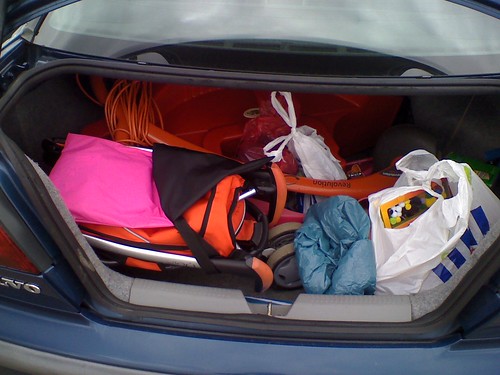
Image courtesy of oklah.blogspot
Take some time to clean up and remove any excess t items that are not necessary inside your car. This will be helpful especially on hill slopes where you will need to press for more gas to gain a steady speed. By travelling light, you will also be helping protect the environment, as the less fuel you burn, the fewer emissions your car will produce.


Monday, January 21, 2013

Car tips: How to save fuel on long journeys

Car tips: How to save fuel on long journeys

By  10 hours ago
Roadtrips! We all love going on a roadtrip but the increasing fuel cost can put a damper on our mood so we end up giving a bunch of excuses when it comes to a long distance journey.
*Words and pictures by Nooralia Zaharin
To ease your burden we’ve got 5 fuel saving tips that can help you improve your car’s fuel economy and take some of the sting out of high fuel prices.
1. Pump up the volume; and those tyres.
This is going to sound really corny but proper tyre inflation beats inflation. The correct tyre pressure is essential to getting the best mileage out of every tank of fuel in your car. Remember this: 20 per cent of every full tank is burned up via frictional losses just to push the tyres across the asphalt.
This percentage climbs dramatically if your tyres are improperly inflated. It’s best to check the pressure when the tyres are cold, but more importantly, make it a habit to inflate them when you fill up your petrol tank before a long journey.
If your tyres are hot when you’re pumping them, add a couple of bars (psi) more to the pump to make up for the expanded hot air in the tyres. And remember, if you car is equipped with a spare tyre in the boot, make use it’s pumped too.
2. Drive smoothly
Traffic jams are the worst culprits for elevated fuel consumption. Stop / start driving is one of the greatest enemies of fuel efficiency because when the average speed of your vehicle changes from 40kmh to 20kmh, the fuel consumption will decrease by 30 per cent.
That’s why your car always records its best mileage when you’re cruising on the open highway so if at all possible, try to avoid situation that requires a lot of stop and go driving, but if you’re unable to, then be gentle on the accelerator pedal. Avoid harsh acceleration, and be as smooth as possible on the pedal.
3. Remove weight
Take note that 3 per cent of fuel will be saved for every 100kg of less weight. So if you’re able to lighten the load of your car, the engine has less of a load to push around and hence uses less fuel.
Whenever possible, do a spring cleaning on your car; remove all the stuff you hardly use from its interior and boot, you’ll be amazed how much junk your car accumulates and even more surprised how much all this weighs.
4. Constant velocity
It takes more fuel to get a car rolling to 110kmh, than it does to keep it rolling at 110kmh, therefore, get your car to its top gear as quickly as possible without over-revving it, and try to maintain a constant speed. You’ll even notice that your revs drop significantly despite driving at a decent clip.
For a car with automatic transmission, the on-board shift computer will figure out the best time to shift gears for you, but for cars with a manual tranny, refer to your owner’s handbook to see at which rpm your car makes its optimum power. If it’s say 3500 or 4000rpm, shift gears 500rpm before that, because anything after is just a waste of petrol.
5. Proper maintenance
Just as how your body would not function properly without proper rest, sustenance and exercise, your car will not perform at its best if improperly maintained. And yes, because the one thing that keeps it moving is petrol, your car will burn more of it unnecessarily to keep itself running if it’s not in the best shape.
Regular maintenance and proper care are essential to getting the best performance from your car, not just in terms of power, but fuel efficiency as well. In addition to getting your car serviced regularly, fortnightly DIY checks are also recommended, if only to check fluid levels. Always see to warning lights that appear on your dashboard warning you about something, and remember, the longer you ignore it, the more expensive it’s going to be.